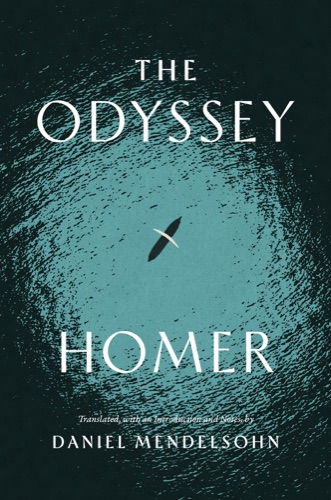
Mendelsohn’s 2025 translation uses a six-beat English line and keeps one English line for each Greek line. That gives him more room than Wilson’s pentameter while preserving a rule that Fagles’s free verse does not follow. In the opening, “roundabout ways” keeps the hero’s epithet spatial, behavioral, and a little strange. It does not settle the phrase into one trait.
Put him beside Wilson and the difference becomes easy to hear. Both translators impose a clear line-for-line rule, but they use the available space differently. Wilson’s tighter line pushes toward speed and compression. Mendelsohn can keep more qualifications in play before the line closes. That is useful when we want formal discipline without quite so much pressure to condense.
We can hear the longer measure in all three passages. The Cyclops name becomes “No-One,” which makes the non-name clear on the page without going as far as Fitzgerald’s respelling. In the reunion, Mendelsohn keeps the bodily formula explicit. Penelope’s recognition does not become entirely a matter of inner feeling. His English is expansive, but the Greek line organizes that extra space. Drama alone does not.
This is the newest major translation in our guide. That is both its attraction and its caution. It joins current debates about fidelity with a clear formal answer, but it does not yet have the decades of classroom use behind Fitzgerald, Lattimore, or Fagles. Choose it if you want a contemporary scholarly translation with a roomy line. Wilson moves faster. An older standard will be easier to place in a history of teaching and criticism.
Read it if you want a contemporary scholarly voice and are curious about the newest major translation.
Skip it if you prefer a version with decades of classroom use and plenty of reader commentary.
Three passage previews
We took each excerpt from the cited source edition and tell you where to find it in the book.
Tell me the tale of a man, Muse, who had so many roundabout ways To wander, driven off course, after sacking Troy’s hallowed keep; Many the peoples whose cities he saw and whose ways of thinking he learned, Many the toils he suffered at sea, anguish in his heart As he struggled to safeguard his life and the homecoming of his companions. But he did not save his companions even so, though he longed to, For their heedlessness destroyed them, theirs and nobody else’s— Fools that they were, like children, who devoured the sun-god Hyperion’s Cattle, and so he took from them the day of their homecoming. Goddess, start where you will; daughter of Zeus, share the tale with us too.University of Chicago Press ebook (2025) · Book 1, opening invocation
‘Cyclops, you’ve been asking me for my famous name and now I shall tell you—and then you’ll give me the guest-gift you’d promised me. No-One is my name. No-One is what people call me, My mother and my father and all of my comrades, too.’ My words. And there came right away this reply from his pitiless heart: ‘I’ll eat No-One last of all, after the rest of his comrades. First I’ll eat the others—that will be your guest-gift!’ He teetered and fell down, flat on his back, and then Lay there, his massive neck bent at an angle. Then sleep, Which subdues all, seized him. Wine ran out of his gullet— Morsels of human meat, too. Loaded with wine, he kept belching.University of Chicago Press ebook (2025) · Book 9, false-name exchange and aftermath
Right then and there, her knees and her heart gave way When she recognized the sure signs Odysseus had clearly described. Bursting into tears, she ran up to him, throwing her arms Around Odysseus’s neck and kissing his head as she said: “Don’t be vexed with me, Odysseus, since in all other things You were always so sensible. But the gods have given us sorrow— The gods who begrudged us the chance to remain at each other’s side While enjoying the days of our youth and then reaching the threshold of age.University of Chicago Press ebook (2025) · Book 23, recognition and reunion after the bed test