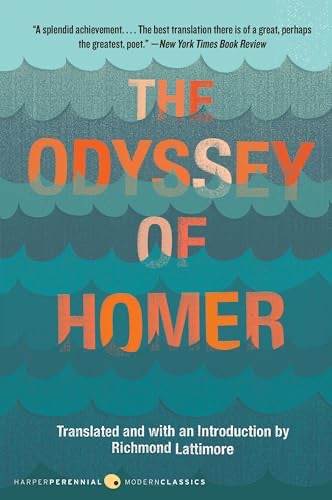
We recommend Lattimore when you want to feel the Greek pressing on the English. His long line makes room for syntax, formulas, and repeated terms that smoother translations often rearrange or vary. In the opening, “man of many ways” says less for us than Wilson’s “complicated,” and it is less theatrical than Fagles’s phrasing. Its value is that we can still see the underlying epithet.
This changes how we read. With Lattimore, a phrase that returns is something to notice rather than something to hurry past. The English gives us a better chance to recognize a formula when Homer uses it again. That makes the translation useful beside a commentary or another version, even when it is not the version we would choose for the fastest first reading.
That habit continues in the other passages. The Cyclops gets the familiar “Nobody.” When Penelope recognizes Odysseus, Lattimore keeps the paired bodily response, knees and heart, near the surface. Repetitions that may sound awkward in ordinary English often count as evidence here. They let us notice how Homeric composition works instead of smoothing it away.
This is not word-for-word neutrality. No verse translation can give us that. Lattimore’s long line and Greek-shaped syntax sometimes put English clauses in an order that makes us read twice. Wilson or Fagles will usually be easier on a first encounter. But if you are tracking formulas, consulting the Greek, or asking what a smoother version has reorganized, Lattimore’s resistance is the point.
Read it if you want to stay near the Greek and do not mind English that sometimes shows the pressure of the original.
Skip it if your first priority is easy modern phrasing or cinematic momentum.
Three passage previews
We took each excerpt from the cited source edition and tell you where to find it in the book.
Tell me, Muse, of the man of many ways, who was driven far journeys, after he had sacked Troy's sacred citadel. Many were they whose cities he saw, whose minds he learned of, many the pains he suffered in his spirit on the wide sea, struggling for his own life and the homecoming of his companions. Even so he could not save his companions, hard though he strove to; they were destroyed by their own wild recklessness, fools, who devoured the oxen of Helios, the Sun God, and he took away the day of their homecoming. From some point here, goddess, daughter of Zeus, speak, and begin our story.HarperCollins ebook (2009; translation copyright 1965 and 1967) · Book 1, opening invocation
“Cyclops, you ask me for my famous name. I will tell you then, but you must give me a guest gift as you have promised. Nobody is my name. My father and mother call me Nobody, as do all the others who are my companions.” So I spoke, and he answered me in pitiless spirit: “Then I will eat Nobody after his friends, and the others I will eat first, and that shall be my guest present to you.” He spoke and slumped away and fell on his back, and lay there with his thick neck crooked over on one side, and sleep who subdues all came on and captured him, and the wine gurgled up from his gullet with gobs of human meat. This was his drunken vomiting.HarperCollins ebook (2009; translation copyright 1965 and 1967) · Book 9, false-name exchange and aftermath
So he spoke, and her knees and the heart within her went slack as she recognized the clear proofs that Odysseus had given; but then she burst into tears and ran straight to him, throwing her arms around the neck of Odysseus, and kissed his head, saying: ‘Do not be angry with me, Odysseus, since, beyond other men, you have the most understanding. The gods granted us misery, in jealousy over the thought that we two, always together, should enjoy our youth, and then come to the threshold of old age.HarperCollins ebook (2009; translation copyright 1965 and 1967) · Book 23, recognition and reunion after the bed test