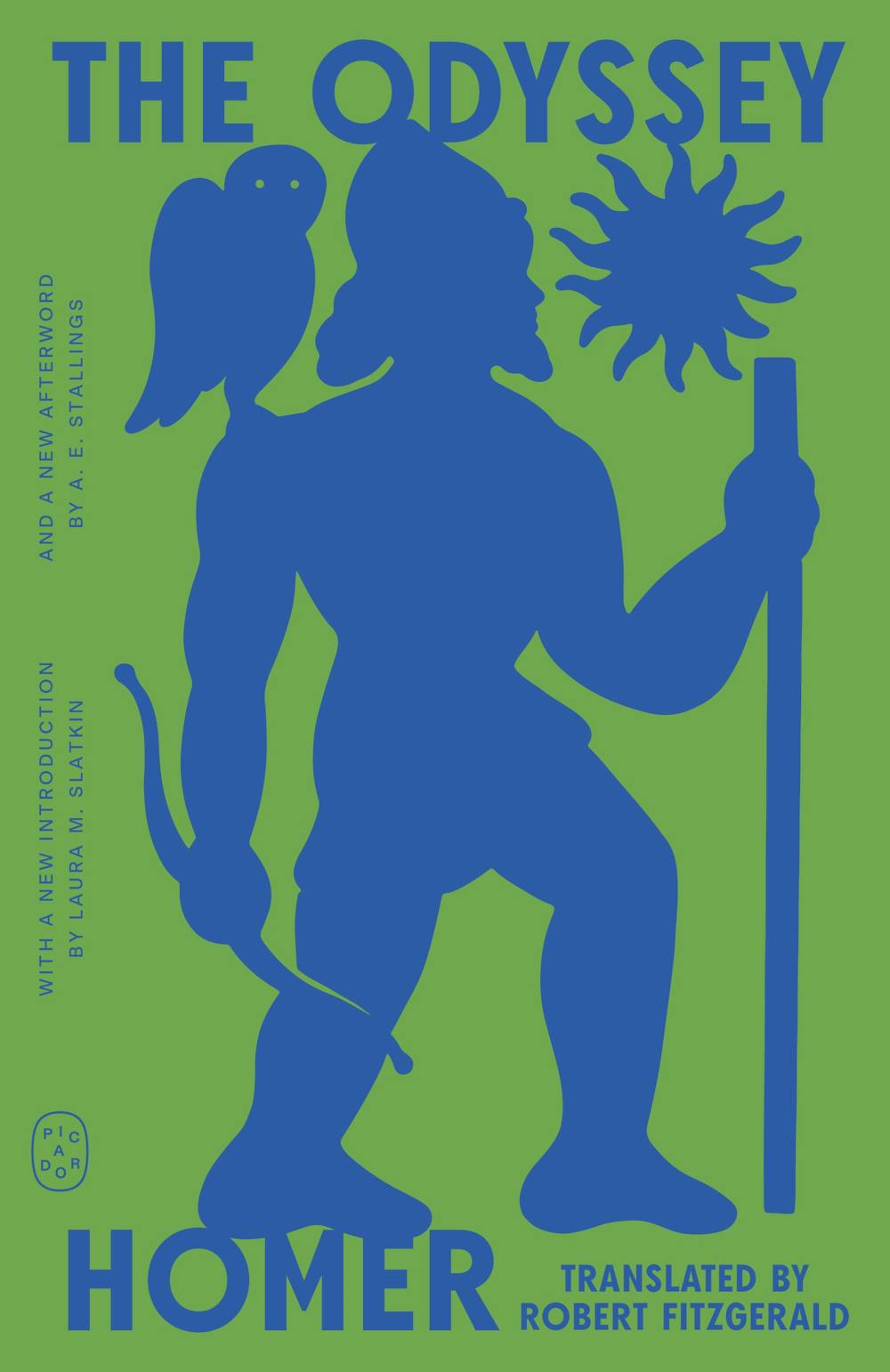
Fitzgerald’s Odyssey still works because it reads like a finished English poem, not a line-by-line aid to the Greek. His flexible blank verse moves between stately narration and tight lyric passages. He has a strong instinct for where a scene should turn. At the opening, “Sing in me” makes the poet an instrument of the Muse. The invitation feels more inward than the direct addresses we hear in Wilson or Fagles.
We should not mistake that polish for mere decoration. Fitzgerald uses the shape of his English sentences to guide us through a scene. A detail arrives, the pressure builds, and the turn comes where an English poem wants it. That can take us farther from the visible structure of the Greek, but it also explains why the translation remains satisfying when read straight through.
His boldest choice in these passages is “Nohbdy.” The spelling makes the Cyclops trick impossible to miss on the page, though it sounds less like natural dialogue. In the reunion, Fitzgerald compresses Penelope’s recognition into a controlled emotional break. That combination of clear staging, lyric force, and selective freedom helps explain why the translation became a lasting classroom and literary standard.
The cost is that we can hear its period. Some phrases have the polish and elevation of mid-century American poetry, and readers used to Wilson’s contemporary syntax may feel the distance. Fitzgerald also does not show line-by-line correspondence as clearly as Lattimore does. Read him when you want a translation with a poetic mind of its own. Choose another when “modern” means present-day language, or when the English must also serve as a map back to Greek structure.
Read it if you want literary elegance and a version that shaped generations of English-language readers.
Skip it if you want contemporary language or a translation that makes its formal choices easy to track.
Three passage previews
We took each excerpt from the cited source edition and tell you where to find it in the book.
Sing in me, Muse, and through me tell the story of that man skilled in all ways of contending, the wanderer, harried for years on end, after he plundered the stronghold on the proud height of Troy. He saw the townlands and learned the minds of many distant men, and weathered many bitter nights and days in his deep heart at sea, while he fought only to save his life, to bring his shipmates home. But not by will nor valor could he save them, for their own recklessness destroyed them all— children and fools, they killed and feasted on the cattle of Lord Hêlios, the Sun, and he who moves all day through heaven took from their eyes the dawn of their return. Of these adventures, Muse, daughter of Zeus, tell us in our time, lift the great song again.Farrar, Straus and Giroux ebook (2011; 1998 edition of the 1961 translation) · Book 1, opening invocation
‘Kyklops, you ask my honorable name? Remember the gift you promised me, and I shall tell you. My name is Nohbdy: mother, father, and friends, everyone calls me Nohbdy.’ And he said: ‘Nohbdy’s my meat, then, after I eat his friends. Others come first. There’s a noble gift, now.’ Even as he spoke, he reeled and tumbled backward, his great head lolling to one side: and sleep took him like any creature. Drunk, hiccuping, he dribbled streams of liquor and bits of men.Farrar, Straus and Giroux ebook (2011; 1998 edition of the 1961 translation) · Book 9, false-name exchange and aftermath
Their secret! as she heard it told, her knees grew tremulous and weak, her heart failed her. With eyes brimming tears she ran to him, throwing her arms around his neck, and kissed him, murmuring: “Do not rage at me, Odysseus! No one ever matched your caution! Think what difficulty the gods gave: they denied us life together in our prime and flowering years, kept us from crossing into age together.Farrar, Straus and Giroux ebook (2011; 1998 edition of the 1961 translation) · Book 23, recognition and reunion after the bed test