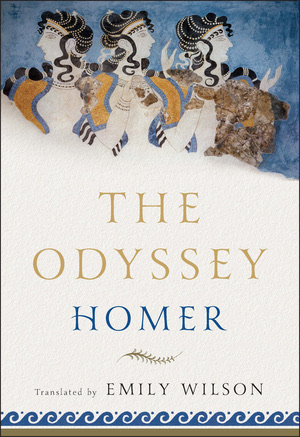
We recommend Wilson first because her formal rule produces real clarity. She uses iambic pentameter and keeps one English line for each Greek line, but her sentences rarely sound as if they are filling out an exercise. In the opening, “complicated” starts interpreting Odysseus at once. He is not simply ingenious or well traveled. He is hard to reduce to one moral quality. That choice fits a translation that pays close attention to power, status, and the names people give one another.
That first word also tells us something important about Wilson’s method. Her clarity is not the same thing as neutrality. She makes a choice, lets us hear it, and then keeps the sentence moving. This makes the translation especially good for a first reading: we can follow the story without pretending that the difficult questions have disappeared.
The same economy shapes the other passages. In the Cyclops exchange, “Noman” lets us hear the trap without stopping the scene to explain it. At the reunion, the release after the bed test arrives quickly and physically. Wilson does not enlarge it into a grand emotional scene. In all three passages, she tends to make the action clear before she ornaments it.
That directness also has a cost. The poem can feel smaller in the mouth than it does in Fagles. If you want the English to preserve more of Homer’s repeated phrasing, you may prefer Lattimore. But if our test is whether a new reader will continue into the next book, Wilson gives us the best balance of verse form, momentum, and sharp interpretation.
Read it if you want a swift first reading, lucid sentences, and a consistent poetic line.
Skip it if you want the rolling, ceremonial grandeur of an older and looser English epic.
Three passage previews
We took each excerpt from the cited source edition and tell you where to find it in the book.
Tell me about a complicated man. Muse, tell me how he wandered and was lost when he had wrecked the holy town of Troy, and where he went, and who he met, the pain he suffered in the storms at sea, and how he worked to save his life and bring his men back home. He failed to keep them safe; poor fools, they ate the Sun God’s cattle, and the god kept them from home. Now goddess, child of Zeus, tell the old story for our modern times. Find the beginning.W. W. Norton & Company first-edition ebook (2018) · Book 1, opening invocation
‘Cyclops, you asked my name. I will reveal it; then you must give the gift you promised me, of hospitality. My name is Noman. My family and friends all call me Noman.’ He answered with no pity in his heart, ‘I will eat Noman last; first I will eat the other men. That is my gift to you.’ Then he collapsed, fell on his back, and lay there, his massive neck askew. All-conquering sleep took him. In drunken heaviness, he spewed wine from his throat, and chunks of human flesh.W. W. Norton & Company first-edition ebook (2018) · Book 9, false-name exchange and aftermath
At that, her heart and body suddenly relaxed. She recognized the tokens he had shown her. She burst out crying and ran straight towards him and threw her arms around him, kissed his face, and said, “Do not be angry at me now, Odysseus! In every other way you are a very understanding man. The gods have made us suffer: they refused to let us stay together and enjoy our youth until we reached the edge of age together.W. W. Norton & Company first-edition ebook (2018) · Book 23, recognition and reunion after the bed test